In addition to getting Elitecoach.me site updates via twitter and direct here on the site, I've created an email subscription to get a periodic list of updates and popular posts direct to your inbox.
Sign up here:
In addition to getting Elitecoach.me site updates via twitter and direct here on the site, I've created an email subscription to get a periodic list of updates and popular posts direct to your inbox.
Sign up here:
Athletics coach Steve Magness has a nice article at his Science of Running blog, on intervention training studies and why many 'new' protocols might 'work' in the lab, but might not be giving the full picture in the 'real world'
"Too often we get caught up in isolation, and forget the complexity and interaction that surrounds the isolation."
In summary, we always respond to short term change, but that doesn't mean that change is in the right direction for the longer term for our performance goals.
This is a real problem with applied sports science research and it's application for coaches, and why while keeping current with the latest research is a good tool for coaches, changing programme direction as a result of research may not be a good strategy over the longer term.
Follow Steve on twitter @stevemagness
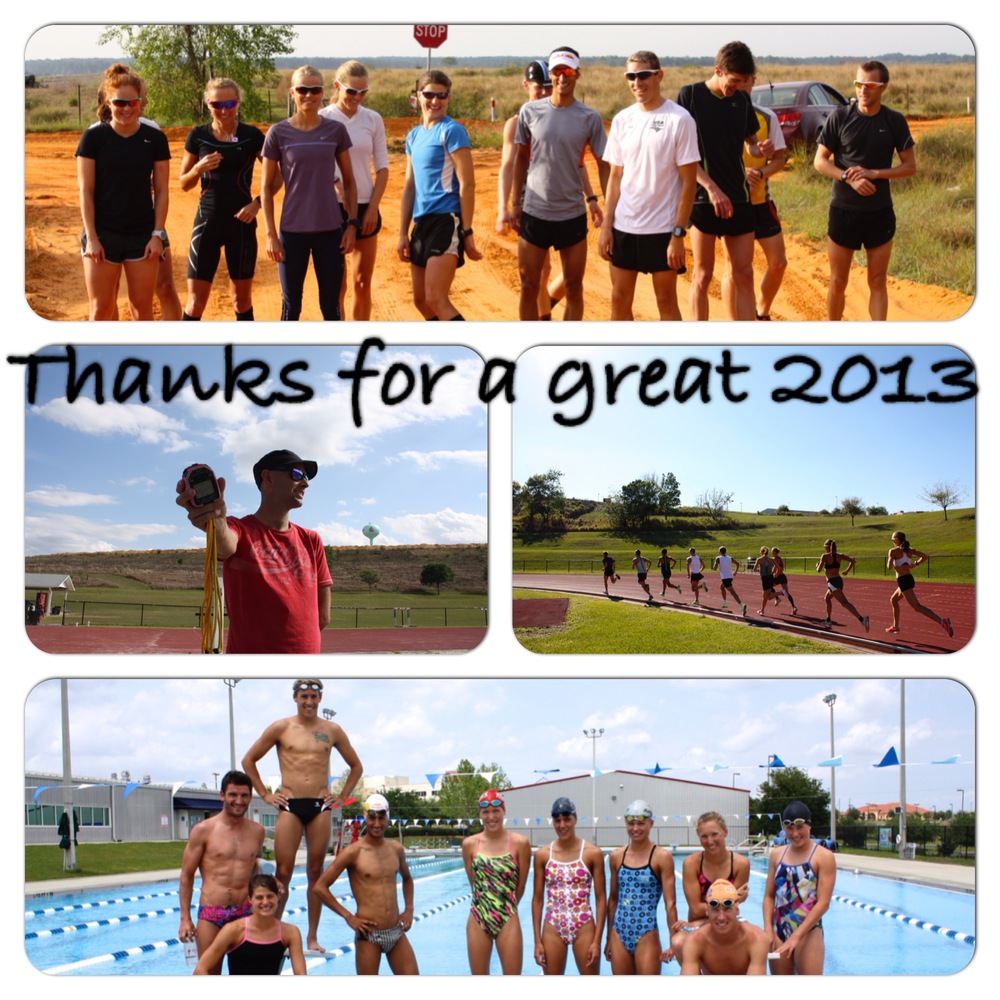
Our 2013 Squad review is here
Top 13 of 2013 - Squad Review
At the end of the year, it's been great to reflect on the last 12 months, with just few of the achievements from the athletes part of our team. In alphabetical order -The Top 13 of 2013
Read the rest on JoelFilliol.com
At the end of the year, it's been great to reflect on the last 12 months, with just few of the achievements from the athletes part of our team. In alphabetical order -
The Top 13 of 2013
1. Alicia Kaye USA - Winner Lifetime Fitness Series - Alicia was the non-draft Olympic distance boss this year, winning the Lifetime Series, including the final in Oceanside, and the male/female Equalizer. @AliciaKayeTri
2. Carol Routier ESP - Podium Sarasota ITU Cup - While young Spanish athlete Carol is known for leading WTS swims, she has moved forward all around, shown by a strong 2nd in Sarasota in a breakaway with two team mates. @CarolRoutier
3. Helle Frederiksen DEN - 2x 70.3 debut wins - Helle dipped her toe into the non-drafting world in 2013, and made and impact with her first two efforts over the half Ironman distance producing two solid wins. @helle_f
4. Jarrod Shoemaker USA - 70.3 Debut Puerto Rico - While not usually known for his bike power, Jarrod put in a strong first 70.3 performance in San Juan, finishing 6th in a competitive field of specialists. @jarrodshoemaker
5. Kyle Jones - Canadian Champion - Kyle returned to the Edmonton this year to defend his National title and won again in style. Can't wait for Edmonton 2014 Grand Final. @JonesKyle
6. Mario Mola ESP - 3rd & 3rd in London WTS - Former World Junior Champion Mola had a breakout season this year, with three WTS podiums, and third overall in the ITU World Series. @mariomola
7. Mirinda Carfrae AUS - Kona Champion - Although we only had a short time with Rinny before coach Siri Lindley took the reigns in Boulder for the second half of the year, it was great to be involved in a small way with Rinny’s fantastic performance in Hawaii. @Mirindacarfrae
8. Paula Findlay CAN - Winner Sarasota ITU Cup - Paula had a building year, focused on gaining strength and returning from challenges she faced in the lead up to London 2012, however with her Sarasota performance she showed she can still win, and will be back. @PaulaFindlay
9. Richard Murray RSA - 2nd in San Diego WTS - Rich had a strong season overall, finishing 5th overall in the ITU World Series and highlighted by a stand out second in San Diego. @RD_murray
10. Sarah Groff USA - Racing like a Boss - Coming off her inspiring London 2012 campaign, Groffy took a different approach to ’13 and went all in for San Diego, Madrid, and London, making important changes for the build to Rio. @sgroffy
11. Tommy Zaferes USA - Winner Brazil FAST Triathlon - I had never heard of a race director asking an athlete to slow down to avoid lapping out the field, but that happened to Tommy in Brazil. @tzaferes
12. Vendula Frintova CZE - Euro Champs Bronze Medallist - Vendula raced with guts at the european champs in Turkey, running from the front pack, and coming away with another European medal. @VendulaShouldGetTwitter
13. JFT Squad - Zero to Heroes - From zero in 2011, building from two Olympians in London 2012, to a superb group of athletes working together in 2013, we had amazing performances, and really enjoyed the process along the way.
2014 brings a further evolution of our squad, with new athletes, new staff, and sure to be outstanding performances and good fun. Our 2014 roster will be announced on JFTracing.com in the new year, follow along & at JoelFilliolCoaching on FB.
I'm usually more interested in experts who are out in the field practising their craft at the coal face, compared to professional presenters/speakers, however on RobinSharma.com there is a post about 53 lessons learned, which has some thought provoking points applicable to coaches. Here are a few I selected:
"Success has less to do with hard work and more to do with massive focus on your few best opportunities."
"Real leaders have the guts to have the hard conversations."
"Self-belief is so incredibly important. Because if you don’t believe you can achieve a vision/goal, then you won’t even start to do the work needed to achieve that vision/goal."
"Our biggest enemy is our own self-doubt. We really can achieve extraordinary things in our lives. But we sabotage our greatness because of our fear."
"You rarely go wrong when you trust yourself."
"Small little details done excellently and consistently stack up into something the world sees as Mastery."
Any coach can see something applicable to their coaching context in that list.
Sefu Bernard has a post on his Thellabb.com site based on an interview/quote with Mark Cuban based on the following question:
“How can I work in the professional sports?”
The advice Cuban gives is that professional sports is very difficult to get involved with due to the demand, so don't bother.
I see the same question from athletes and coaches - "how can I become an elite coach" or how do a 'turn pro' - my answer is the same as the conclusion of Sefu's article:
"Persistence pays off."
Follow Sefu's coaching education site on twitter: @TheLLaBB
Propel Perform has a guest post from Sports Performance Coach Jorge Carvajal about a conversation he had with a young coach about lessons learned. He had these three pieces of advice:
“Trust your abilities as coach!”
“The athlete needs to be sold.”
‘’Be an economist with you program design!”
Read the full article to get the context behind Jorge's answers.
Follow Jorge Carvajal @carvperformance
Performance sport conference promoters Leaders in Performance launched a free (with registration) quarterly magazine earlier this year - the first issue is quite good and has a fair bit of content on planning, injury management, psychology, book recommendations, among other topics. Worth a read.
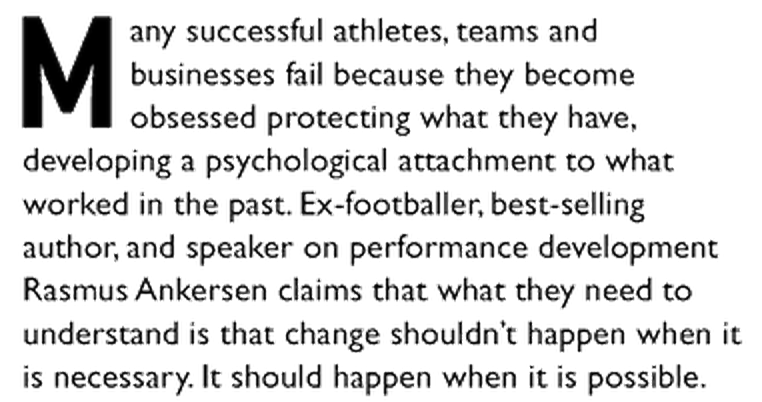 Excerpt from Rasmus Ankersen's article: "If it ain't broke, Fix it"
Craig Payne's Running Research Junkie site has a good article that cuts through the BS on running injuries, and the various ways coaches attempt to avoid injuries. The article touches on several variables: the training programme, foot biomechanics, stretching, strengthening, running shoes, and running form, looking at evidence in each area to reach the following conclusion:
"You can not decrease the load in one tissue with changes in running technique, running shoes, strengthening or foot orthotics or any other approach without increasing it in another tissue."
"It all boils down to: load management."
Essentially, all tissues have load limits, these can be managed, and loads shifted between areas, however ultimately simplest way to manage these loads is the external load of the training programme. Some athletes have lower load limits before injuries occur than others, and our job as coaches is to progressively increase the load limits in our athletes with minimal injuries due to exceeding these limits.
Follow Craig Payne on twitter.
Joseph Lightfoot has an article on the athlete-centred approach of British Cycling - described as Kings and Queens:
“We put the riders in the middle; we’re just the minions around them giving them expert advice.”
“Having the riders in the middle having ownership and having responsibility for what they’re doing is one of the key things that we try to promote. And it seems to work.”
“The ‘athletes are kings and queens’ with everyone else there to support them. That philosophy runs through British Cycling and Team Sky.”
Many federations, teams and governing bodies claim to be athlete-centred, and in some cases coach-driven. In practicality, it's tougher to implement, and rare to actually pull this off, as these bodies often struggle with communication and resort to authority, which is easier to implement than athletes having a true voice in the programme.
When programmes aren't athlete centred, coach driven, there is often a lot of wasted resources, as these resources aren't driven by needs or problems to be solved, but instead are 'check-list' based, driven by funding bodies too far from the coal-face, which means many of these resources don't meaningfully contribute to athlete performance.
The Kings and Queens model is ultimately the best one for senior experienced athletes, and should be scaled for developmentally athletes, teaching them to learn how to drive their own programme, while still leading them in the right direction.
Lightfoot's article has some suggestions on how this model applies to programmes with more limited resources, and how to make it work.
Part 3 of the video interview with American sprints coach Dan Pfaff, via Stuart McMillan:
Follow Pfaff on twitter.
Part 2 of the video interview with American sprints coach Dan Pfaff, via Stuart McMillan:
Follow Pfaff on twitter.
This series of videos from American sprints coach Dan Pfaff via Stuart McMillan is full of wisdom of real coaching, worth a watch and favourite:
Follow Pfaff on twitter.
I've started a small side project on elite coach education started on a new site: http://www.elitecoach.me/ and via twitter @ https://twitter.com/elitecoachme
It's a work in progress, as I find resources that I find useful, I'll add to the site.
Starting off with a video from a 2008 post-Beijing talk I did with Simon Whitfield:
This video is the Beijing 2008 Olympic Reflections talk I did with two time Olympic medallist Simon Whitfield, in November 2008, held at PISE in Victoria BC Canada.
ESPN has an article on the stress NFL Head Coaches face, for many to the detriment of their health. While not many endurance coaches face the same pressures as big money professional sports coaches such as in the NFL, the 12 month a year, 'no off-season' nature of endurance sports can mean many coaches don't unplug and take a break.
While many endurances coaches also participate in the sports they preside over, thereby keeping a level of fitness, the principle of taking care of ones self remains important to maintain and continually improve coaching standards. The same principles apply as with athletes, regeneration breaks are important for coaches to re-fresh creativity, for critical reflections and to gain new perspectives.
"I'd lose on Sunday, and I'd spend three days worrying about what I had to do win the next game," he continued. "And the enjoyment of a win would last a half-hour. But I'm not unique. I know two Hall of Fame coaches who came to me and talked about going through similar problems. I told them that there's only so much you can do. It's like an engine. You can blow up a Porsche if you drive it too hard, and a football coach is no different. You have to find a way to turn it off."
Leading into Olympic Games, a principle that often comes up in preparation meetings, is the coaches and staff arriving at the games fresh, fit and ready to perform, in much the same way as athletes must do.
Another great quote from the article is the following:
"you can't worry about every little thing in your preparation that you end up chasing ghosts."
This stands in contrast to the current in-vogue 'aggregation of marginal gains', or, put another way: don't lose sight of the forest for the trees.
Athletics Illustrated has an interview with physiologist and coach Trent Stellingwerff on the 'Belief Effect', delving into psychology working with athletes and coaches.
Trent works for the Canadian Sports Centre Pacific, the multi-sport sports agency, supporting Olympic sports in Victoria, and Vancouver.
I had the opportunity to work with Trent when based in Victoria - he's one of the few scientists that understands the practicalities of implementation of research into athlete programmes, and gets the coaches mindset, and specific challenges coaches face.
In this interview Trent discusses the complex relationship between athlete and coach belief in their programmes, particularly in the face of the desire for more practise to be 'evidence based'. In reality often coaches and athletes are 'ahead' of research but believe in their practise, whether there is evidence to support what they are doing or not - see the continual use of altitude training world wide, despite the relative dearth of strong evidence that altitude training 'works'.
This isn't to say coaches should ignore evidence or not question their practises, but that belief is a very important element of coaching, and likewise athletes must believe strongly in what they are doing - and for both athletes and coaches the ultimate evidence base is performance - even if we know performance is so complex and multi-factorial that drawing links to a specific intervention is not usually possible in any case.
"However, as an applied sport practitioner I am not concerned about bias – I want to leverage all the bias I can get into “belief”. And that belief is included in myself and belief by the athlete and coach. To me this is not fraudulent. If I have done my homework (e.g. studied for 20-plus years, looked at all the research papers, reached out to my international network for insider information, done some internal research and trial/error) and I truly believe in an intervention, I want the athlete/coaches I work with to know that I am convinced this will help them, that I have done my homework, and that they are in good hands with me – that they have a strategic advantage by applying new knowledge into a new intervention. In this situation, we have both evidence and belief maximized – which is perfect in the applied sport sciences as both have been shown to improve performance separately."
Follow Trent on twitter.
Oliver Burkeman has an article on Impostor Syndrome, something that many freelancers, including coaches can feel:
"Impostor syndrome – the feeling that you're a fraud, and any day now you'll be exposed – is presumably even more common than surveys suggest: after all, it's not the kind of thing to which people like to admit."
"The only solution, many experts say, is for higher-ups to talk about their own insecurities much more."
This can be particularly relevant in a world with access to so much information, once a coach gets enough knowledge and experience to understand how complex each individual athlete and situation can be.
"The trouble with the world is that the stupid are cocksure and the intelligent are full of doubt," said Bertrand Russell.
If as a coach you don't occasionally lay awake at night pondering the sessions to be delivered the next day, you be find the quote above applicable to you.
However coach that does feel some doubt, according to this article, it might be a sign the coach is on the right track.
This article from Science Daily interviews Jim Denison, of the Canadian Athletics Coaching Centre, is full of great points on the need for coaches to avoid becoming complacent, and instead seek to be continual learning and evolution in their coaching practice:
"Coaching is complex, continually changing and influenced greatly by the context, athletes' circumstances and the developing relationship between the coach and the athlete."
"There's good research that shows that when coaches achieve this expert status they tend to want to maintain that," he says, "so admitting that you don't know becomes a threat to their expertise."
"Often the most successful coaches are the ones who are most willing to adopt a lifelong learning approach and to admit that they don't know," says Denison, who advocates "problem-setting" -- determining whether there is indeed a problem, before "problem-solving."
I'd add that a level of humility also goes a long way in coaches - the more you know, the more you know you don't know.
Another uCoach Video, this one on current British Athletics Head of Endurance Dr Barry Fudge, physiologist and advisor to Mo Farah. Barry has a very practical and down to earth perspective on sport science and understand the implementation challenges with many performance interventions, which can appear to be very beneficial on paper, but putting them into a programme is not always straight forward.
Dr. Fudge also talks about his role as a physiologist and talks in detail about the British athletics program, he explains how, why and when athletes can best use altitude and shows how an endurance program set up leading into the London Olympic games has grown and flourished.
http://ucoach.com/video/dr-barry-fudge-talks-on-altitiute-training-for-endruance/
Follow Barry Fudge on twitter.
Note: non-UK users will have to use a work-around to use uCoach resources.