A couple weeks ago I sat down for an interview with Jeff Scull from the Department of Applied Health Sciences at Brock University in Ontario, for a discussion on coaching, inputting on Jeff's research project entitled "Investigation into the motivational strategies among elite triathlon coaches"
International Triathlon Coach Joel Filliol and Jeff Scull from the Department of Applied Health Sciences at Brock University in Ontario will be having a discussion on coaching, inputting on Jeff's research project entitled "Investigation into the motivational strategies among elite triathlon coaches"
This video presentation by Malcolm Brown - Leeds based athletics and triathlon coach - to Olympic Triathlon medallists Alistair and Jonathan Brownlee, among others - has outstanding insight into the Leeds triathlon environment - worth a watch.
SkySports has an article on analytics in football "Future of analytics in football: Time to stop just collecting data and start making some decisions" following on a Sports Analytics Innovation Summit . 'Big data' is a trend in the technology industry, and also in sport, brought into the popular consciousness by the baseball book "Money Ball".
"It’s easy to collect data and feel like we’ve arrived."
While big money professional sports have taken to employing analysts to make sense of the data that is being collected, most coaches don't have access to that type of resource. With the increase in data available for coaches from new technology such as GPS, power meters, we can lose sight of what is important: using the data to make better decisions. Paralysis by analysis is a real problem for coaches, as well as increasing complexification of sport, using up bandwidth which might obscure a coaches' big picture thinking.
“Data is worthless. Only decisions have value.”
This short article from 99u "Reflection is the Most Important Part of the Learning Process" sums up what is critical for any coach, reflection, and why creating opportunities to critically reflect on our coaching practice is essential for on going learning.
Effective reflection should be structured, and is even more powerful when done with a coaching colleague or mentor.
“We do not learn from experience … we learn from reflecting on experience.”
Read the full article and incorporate critical reflection into your daily practise.
"Stress is difficult but stress is also good; it gives you a determination to fight"
A short interview with Liverpool football manager Brendan Rogers: "What's in a day for Rodgers?" with some insight on how he works.
The influence of Psychologist Steve Peters' work with the team can been seen here, with the 'kings and queens' philosophy:
"I then say, it is your responsibility. I will give you all the tools, an elite environment, a high-performance focus, we give you the best people: medical, mental, technical, tactical and I will manage that. "
"All those factors will allow you to perform to a level of excellence. I tell all the players: 'the crown is on your head, you're the king of your destiny.'"
Another quote that resonated was the following about commitment vs motivation:
"I want commitment, not motivation, because motivation is fleeting, it goes by feelings,"
With the pressure and resources going into professional sports, there is always something to learn looking at the processes of the teams behind the teams.
Adam Meakins' site The Sports Physio has an outstanding article on what is really required from physiotherapists working in sport, "So you want to be a Sports Physio" written by by Gary Anderson (@CoachGA), the Performance Director for the Great British Bobsleigh Team and Olympic Team Leader 2014.
“Shit happens, life is not fair and the goalposts do move”
Gary lists his his criteria for selecting his support teams, as well as his performance philosophy.
A few highlights:
- Contribute to team climate
- No opinions in public
- Accept uncomfortable environment
- Never an easy day
- Not about athletes being happy
The article is well worth a read for all coaches, and applies equally to anyone within your team.
"Do not forget the human interaction – effective communication overrides every element of technology or procedure that you have in your armoury. In my experience the body has a very clever way of righting itself in time, you are just trying to accelerate that natural process. Show that you care, show that you have the best performance interest at the for-front of what you do, thst is very powerful for an athlete."
Check out the IM Talk podcast episode I did in studio with John and Bevan while on camp here in Christchurch:
http://www.imtalk.me/home/2014/3/24/imtalk-episode-406-joel-filliol.html
"Nobody runs, skates or cycles faster from biomechanical evaluation only, no matter how many biomechanical factors you measure, there are always more performance factors to consider and to change (or not)."
A good post from Henk Kraaijenhof which captures some of the technological / if we can measure it, it must be useful / interventionist approach that pervades coaching, particularly for those organisations with larger budgets to spend on this sort of approach. It's never black/white, either/or when it comes to measurement or technology, however it's easy to spend energy focusing on the wrong things.
"A patient doesn‘t get better from diagnosis only."
Another good post from Propel Perform - this time from Jeff Janssen on elements of strong performance cultures - 'championship cultures'. Numbers 2, 3 and 4 resonated with me, and reading this article made me consider, and reflect on where my current coaching practice sites with respect to this principles.
1. Credible Leaders
2. Clear and Compelling Vision
3. Core Values
4. Standards of Behavior
5. Aligned Systems
6. Committed and Unified Team Members
Read the full article and follow the author on twitter @janssenleader
Derek Hanson's site Runningmechanics.com has an article on lessons learned on athlete development from the late Charlie Francis, Canadian athletics coach. Due to Francis' links to doping and Ben Johnson specifically, I thought about whether to link to this resource, however the post by Hanson is full of coaching wisdom that deserves to be shared and evaluated on it's on merits.
1. Cast a Wide Net
2. Nothing is Too Fundamental
3. Don’t Be Afraid to Walk Away
4. Adapt to Your Individual Circumstances
5. Coach to Your Athletes’ Strengths
6. Don’t be Tied to One Approach
7. Recovery Will Determine Training Objectives
8. Quality Begets Quality
Read the full article - a great resource for athlete development of any discipline.
Shane Parish's site Farnam Street Blog has the mission to help "master the best of what other people have already figured out." The site is a great resource for coaches, and covers areas such as learning, processing information, useful books, the 'soft skills' such as relationships, rapport, and communication.
This post by Shane nicely links up the aim of EliteCoach.me, and is about learning.
"Most people go though life not really getting any smarter. Why? They simply won’t do the work required."
The summary is to read, and read a lot. But that's not enough - you have to actively read, much like 'deliberate practice' as a coaching concept - passively reading doesn't work. The test is being able to explain the concepts to others. Take notes, and process them, use what you learn.
Read the full post - it's a good one.
A good place to start with the Farnam Street Blog is the best of 2013 post.
If like me you end up collecting a lot to read - download Instapaper to pull material offline to read later in a better format.
The Australian site Propel Perform tweeted this out last week:
"High Performance Heuristic: If your facilities are better than your results... You have a 'decision-maker' problem."
I felt it deserved a slightly longer follow-up than 140 characters.
Modern facilities are not necessary for elite performers, or to have an effective high performance sporting environment. This is good to remember for coaches, who train in older facilities, or facilities without all the bells and whistles. Also for federations or governments interested in promoting sport - better to make memberships free or subsidise participation than have expensive facilities. Of course it's great to do both, but often it's not possible, budgets limiting.
Many of the best performing programmes come from 'basic' facilities. Perhaps the environment created by shiny 'newness' creates the feeling that one has arrived, vs the struggle that high performance sport unpins is about.
I always like the older pool in Victoria BC, Crystal Pool, vs the newer Saanich Commonwealth Place.
Food for thought.
Erik Barker's site Barking Up The Wrong Tree has a lot of good content - often excerpts from books and studies on various themes, such as this post on "The Five Paths To Being The Best At Anything" which touches on the '10,000' hours, 'The Sports Gene', having great team around you, and finding ways to give back.
1. Always work hard to improve.
2. When choosing tasks and strategies, consider your natural gifts.
3. Pick a great team and get familiar with them.
4. Within reason, always help others.
Check out the post and subscribe to Eric's newsletter on the site. Follow Eric on twitter @bakadesuyo
Interesting article from TheAustralian.com.au on Toni Nadal, the coach to tennis star Rafa Nadal, who is also his uncle.
"But he sees among young players a lack of respect to coaches and a wariness of the unrelenting hard work and absolute commitment as reasons why 34 of the past 35 Grand Slam titles have been won by four men."
"Coaches come for players with water, with food - many times I see the player go to the court for practice and the player goes with nothing and the coach has the bag. I have seen many times players who talk to his coach so bad. "
The article resonates particularly for any coach working with Federation supported programmes and athletes. In our efforts to go the extra mile for performance, we can inadvertently create environments where athletes end up with entitled behaviour. They can end up dependant on staff to take care of them and find solutions to problems vs learning how to manage themselves, even if that means making mistakes during their development years.
This reminds me of a discussion with Kiwi/British Coach Ben Bright on the path many young Aussis and Kiwis forged in the early years of triathlon, coming to Europe with nothing, and finding their way as professionals, racing for food and lodging. The modern generation of athletes have more support, but there can be a downside to that support, that they miss these formation development experiences.
Vern Gambetta has a post on his Functional Path Training blog with some lessons and reflections from 2013, a couple of which I have highlighted below, which resonated with me:
"Every year that passes just keeps reaffirming that everything that is old is new again."
"Just because something did not work in the past does not mean it won’t work now - different time, different people, different place and different circumstances."
"Master the basics and never abandon the basics. Everything is built on basics."
Read the full post and follow Vern on twitter @coachgambetta
In addition to getting Elitecoach.me site updates via twitter and direct here on the site, I've created an email subscription to get a periodic list of updates and popular posts direct to your inbox.
Sign up here:
Athletics coach Steve Magness has a nice article at his Science of Running blog, on intervention training studies and why many 'new' protocols might 'work' in the lab, but might not be giving the full picture in the 'real world'
"Too often we get caught up in isolation, and forget the complexity and interaction that surrounds the isolation."
In summary, we always respond to short term change, but that doesn't mean that change is in the right direction for the longer term for our performance goals.
This is a real problem with applied sports science research and it's application for coaches, and why while keeping current with the latest research is a good tool for coaches, changing programme direction as a result of research may not be a good strategy over the longer term.
Follow Steve on twitter @stevemagness
Our 2013 Squad review is here
Top 13 of 2013 - Squad Review
At the end of the year, it's been great to reflect on the last 12 months, with just few of the achievements from the athletes part of our team. In alphabetical order -The Top 13 of 2013
Read the rest on JoelFilliol.com
At the end of the year, it's been great to reflect on the last 12 months, with just few of the achievements from the athletes part of our team. In alphabetical order -
The Top 13 of 2013
1. Alicia Kaye USA - Winner Lifetime Fitness Series - Alicia was the non-draft Olympic distance boss this year, winning the Lifetime Series, including the final in Oceanside, and the male/female Equalizer. @AliciaKayeTri
2. Carol Routier ESP - Podium Sarasota ITU Cup - While young Spanish athlete Carol is known for leading WTS swims, she has moved forward all around, shown by a strong 2nd in Sarasota in a breakaway with two team mates. @CarolRoutier
3. Helle Frederiksen DEN - 2x 70.3 debut wins - Helle dipped her toe into the non-drafting world in 2013, and made and impact with her first two efforts over the half Ironman distance producing two solid wins. @helle_f
4. Jarrod Shoemaker USA - 70.3 Debut Puerto Rico - While not usually known for his bike power, Jarrod put in a strong first 70.3 performance in San Juan, finishing 6th in a competitive field of specialists. @jarrodshoemaker
5. Kyle Jones - Canadian Champion - Kyle returned to the Edmonton this year to defend his National title and won again in style. Can't wait for Edmonton 2014 Grand Final. @JonesKyle
6. Mario Mola ESP - 3rd & 3rd in London WTS - Former World Junior Champion Mola had a breakout season this year, with three WTS podiums, and third overall in the ITU World Series. @mariomola
7. Mirinda Carfrae AUS - Kona Champion - Although we only had a short time with Rinny before coach Siri Lindley took the reigns in Boulder for the second half of the year, it was great to be involved in a small way with Rinny’s fantastic performance in Hawaii. @Mirindacarfrae
8. Paula Findlay CAN - Winner Sarasota ITU Cup - Paula had a building year, focused on gaining strength and returning from challenges she faced in the lead up to London 2012, however with her Sarasota performance she showed she can still win, and will be back. @PaulaFindlay
9. Richard Murray RSA - 2nd in San Diego WTS - Rich had a strong season overall, finishing 5th overall in the ITU World Series and highlighted by a stand out second in San Diego. @RD_murray
10. Sarah Groff USA - Racing like a Boss - Coming off her inspiring London 2012 campaign, Groffy took a different approach to ’13 and went all in for San Diego, Madrid, and London, making important changes for the build to Rio. @sgroffy
11. Tommy Zaferes USA - Winner Brazil FAST Triathlon - I had never heard of a race director asking an athlete to slow down to avoid lapping out the field, but that happened to Tommy in Brazil. @tzaferes
12. Vendula Frintova CZE - Euro Champs Bronze Medallist - Vendula raced with guts at the european champs in Turkey, running from the front pack, and coming away with another European medal. @VendulaShouldGetTwitter
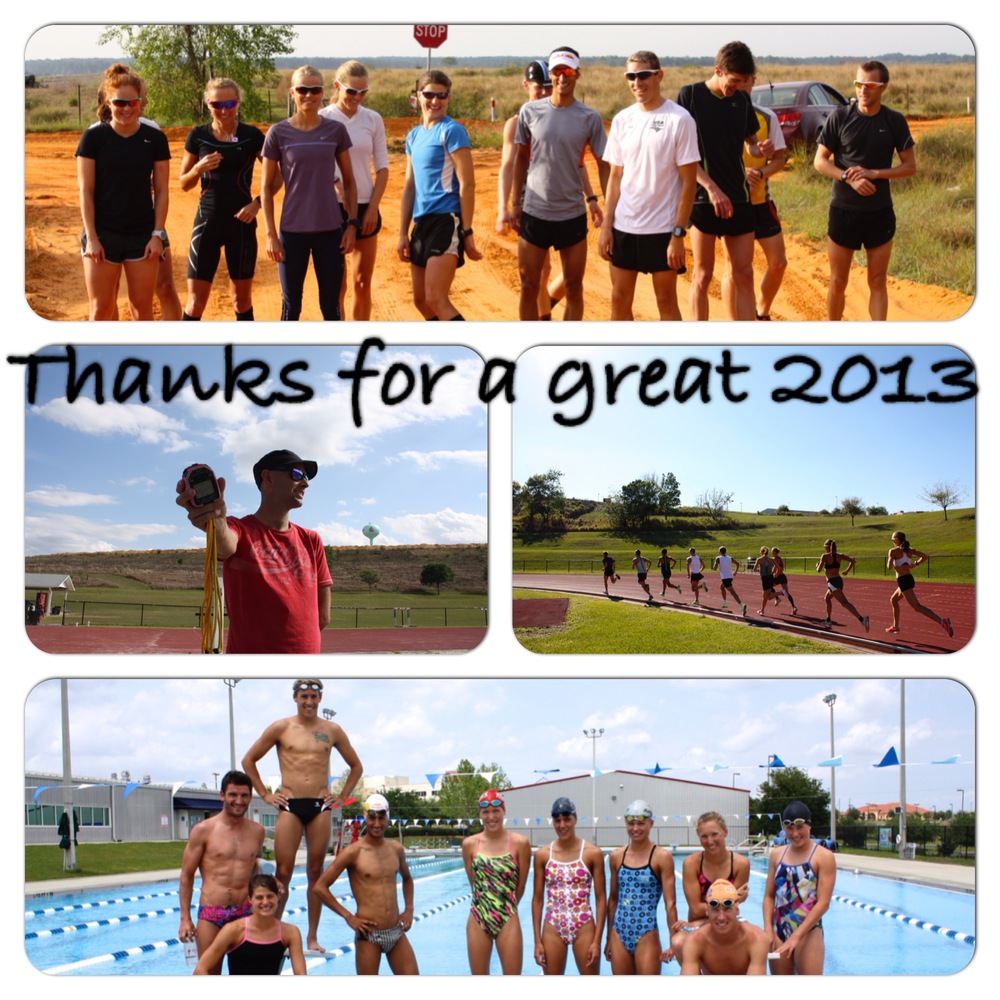
13. JFT Squad - Zero to Heroes - From zero in 2011, building from two Olympians in London 2012, to a superb group of athletes working together in 2013, we had amazing performances, and really enjoyed the process along the way.
2014 brings a further evolution of our squad, with new athletes, new staff, and sure to be outstanding performances and good fun. Our 2014 roster will be announced on JFTracing.com in the new year, follow along & at JoelFilliolCoaching on FB.